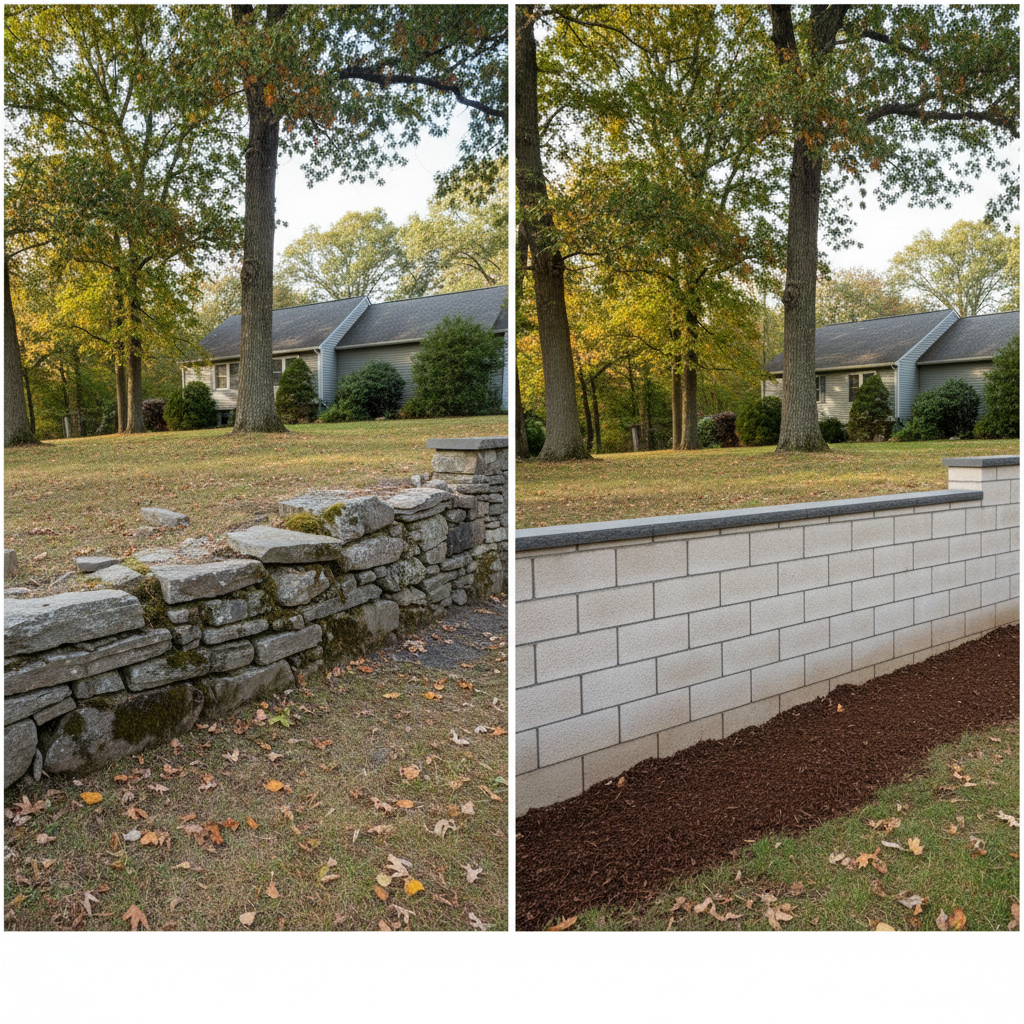
Alright, let's talk block walls. Maybe you're looking to build a sturdy retaining wall, a new foundation, or even just a garden wall. Whatever the reason, you've got a couple of main options when it comes to block construction: Concrete Masonry Units (CMU) and Segmental Retaining Walls (SRW). As a contractor who's built plenty of both right here in Weston, I can tell you there are big differences. Let's break 'em down.
What's the Difference?
First off, CMU blocks are your classic concrete blocks. These are the ones you see in foundations, garages, and commercial buildings. They're usually hollow, designed to be mortared together, and often get reinforced with rebar and filled with concrete for extra strength. Think of them as the basic building blocks of traditional construction.
SRW blocks, on the other hand, are a bit different. They're made to interlock, often using a lip or pin system, and you typically won't use mortar between them. Instead, they rely on their own weight, that interlocking mechanism, and a properly designed gravel base and backfill to create a stable, flexible wall. You'll spot these a lot in landscaping retaining walls.
Cost: Where Does Your Money Go?
When we talk about cost, it's not always as simple as just the block price. CMU walls usually need more skilled labor for mortar work, rebar installation, and often, a poured concrete footing. This can really push up the labor costs. The blocks themselves might be cheaper per unit, but the installation takes more effort.
SRW blocks can sometimes cost a bit more per block, especially if you're picking a decorative face. However, installation can be quicker since there's no mortar curing time, and for shorter walls, you might not even need a deep concrete footing. It's more about getting the base prepared and compacted correctly. For a really large, tall retaining wall, the engineering for an SRW can get complex, sure, but for most residential landscape jobs, they can actually be more budget-friendly on the labor side.
Durability and Longevity
This is where the Weston climate really comes into play. We get those brutal freeze-thaw cycles, don't we? That's tough on any masonry. A CMU wall, if built right with good drainage, rebar, and a solid footing, is incredibly durable. It's meant to be a rigid, permanent structure. It can handle big loads and resists movement very well, assuming it's put together correctly.
SRW walls are designed to be flexible. This flexibility is actually a huge advantage in our climate. Instead of cracking under frost heave pressure, which a rigid wall might do, an SRW can shift a little and then settle back. Now, this doesn't mean they're indestructible; poor drainage or a bad base will still cause issues. But their basic design often makes them more forgiving in areas where the ground moves.
Maintenance Needs
Generally speaking, both types of walls are pretty low maintenance if installed correctly. For CMU, you'll want to keep an eye on the mortar joints over the years. Cracks can show up, letting water in, and that can lead to bigger problems. Repointing might be necessary down the line. You also need to make sure there's proper drainage behind the wall to prevent hydrostatic pressure from building up.
SRW walls also need good drainage. If the backfill gets soaked, the wall can bow or fail. The main thing to watch for with SRW is if individual blocks settle or shift, especially if the base wasn't prepared perfectly. But without mortar, you don't have to worry about repointing, which is a plus.
Appearance and Aesthetics
CMU blocks usually look pretty utilitarian. If you want a finished look, you'll typically need to cover them with stone, stucco, or brick. This adds significant cost and labor. Without a veneer, they're just grey concrete blocks, which might be fine for a foundation that's going to be covered, but not ideal for a visible landscape feature.
SRW blocks come in a huge variety of colors, textures, and shapes. You can find split-face, tumbled, smooth, and all sorts of natural stone looks. They're designed to look good right out of the box, so you don't need extra finishing. This makes them a popular choice for visible retaining walls, garden beds, and terracing around properties in neighborhoods like those near Wellesley Street.
My Recommendation for Weston Homeowners
So, which one should you choose? It really depends on the job. If you're building a foundation for an addition, a garage, or a very tall, heavily loaded structural wall, CMU is usually the way to go. Its rigidity and ability to be reinforced make it superior for heavy-duty structural applications.
However, for most landscape retaining walls, garden walls, or terracing projects around your Weston home, I'd lean towards Segmental Retaining Walls. That flexibility is a huge plus with our freeze-thaw cycles, they look great without extra finishing, and often, the overall installed cost for a decorative wall can be more favorable. Plus, Alpha Masonry Solutions has installed countless SRW walls that stand the test of time and look fantastic.
Ultimately, the best choice depends on your specific project, budget, and what you want the final result to be. Give me a call, and we can talk through your options and figure out what makes the most sense for your property.